Citrix He System Could Not Log You on. Ensure That You Entered Your Details Correctly and Try Again
Navigation
Workspace app is the new name for Receiver. This post applies to all Workspace app versions, and all Receiver versions 4.0 and newer, versions 1808 and newer (eastward.chiliad. 2202), and the LTSR versions.
- Alter Log
- Workspace app versions
- Overview
- Workspace app Modules
- Workspace app Discovery and Beacon Process
- Virtual Monitors
- Uninstall Old Receiver Clients
- Installation and Configuration
- Administrator vs non-administrator
- Workspace app Machine-Update
- Splash Screen
- Add together Account Wizard
- CitrixWorkspaceApp.exe Command line switches
- Workspace app Registry values
- Workspace app Group Policy settings
- Client-side Registry for Microsoft Edge
- Workspace app ADMX GPO Template
- Pass-through Hallmark
- Automatically add StoreFront Accounts to Workspace app
- Command Shortcut placement on Desktop and Start Menu – and Workspace Control (Session Reconnect)
- Enable Prelaunch
- Control Device Mapping Prompts
- Desktop Lock
- Use Studio to configure Workspace app Accounts in Published Desktop
- Published Desktop – configure Workspace app to place shortcuts
- Script / Automate Workspace app and Receiver Cocky-Service
- Microsoft Teams
- Skype for Business organisation
- Troubleshoot:
- Citrix QuickLaunch
- Workspace app Logging
- Clean up Duplicate Stores
💡 = Recently Updated
Change Log
- 2022 Mar 17 – Versions – updated for Workspace app 1912 LTSR Cumulative Update 7
- 2022 February vii – updated entire commodity for Workspace app 2202
- 2021 Dec 9 – Versions – updated for Workspace app 1912 LTSR Cumulative Update 6
- 2021 Dec 8 – updated entire article for Workspace app 2112.one
- 2021 October iv – updated entire article for Workspace app 2109.1
- 2021 Sep 29 – updated entire article for Workspace app 2109
- 2021 Aug xxx – updated unabridged article for Workspace app 2108
- 2021 Aug 11 – Versions – updated for Workspace app 1912 LTSR Cumulative Update v
- 2021 July 29 – updated entire commodity for Workspace app 2107
- 2021 June sixteen – updated entire article for Workspace app 2106
- 2021 May xi – Workspace app 1912 CU4 and Workspace app 2105 and newer gear up security vulnerabilities
- 2021 May 10 – updated entire article for Workspace app 2105
- 2021 May 10 – Versions – updated for Workspace app 1912 LTSR Cumulative Update iv
- 2021 Mar 23 – updated entire article for Workspace app 2103.1
- 2021 Mar 16 – updated unabridged article for Workspace app 2103
- 2021 Feb one – updated entire commodity for Workspace app 2102
- 2021 Jan twenty – Versions – updated for Workspace app 1912 LTSR Cumulative Update iii
- 2020 December 18 – updated entire article for Workspace app 2012.1
- 2020 Dec 8 – updated entire commodity for Workspace app 2012
- 2020 Nov 2 – updated entire article for Workspace app 2010
- 2020 Oct xv – Versions – updated for Workspace app 1912 LTSR Cumulative Update 2
- 2020 Oct 1 – updated entire article for Workspace app 2009.6
- 2020 Sep 24 – updated entire article for Workspace app 2009.v
- 2020 Sep xv – updated unabridged article for Workspace app 2009
Workspace app Versions
Workspace app is the new proper noun for Receiver.

The systray icon for Workspace app is blue instead of black, only Workspace app is otherwise identical to Receiver, except for new features that are only in Workspace app (e.one thousand. Browser Content Redirection, App Protection).

Workspace app uses a YYMM (year/calendar month) versioning format, of which version 2202 (21.12.1) is the newest.

Workspace app 2009 and newer take the new Citrix logo.

Workspace app 1912 and newer support App Protection. It's available in both the LTSR 1912 version and the Current Release 2202 version.

The LTSR (Long Term Service Release) version of Workspace app is version 1912 Cumulative Update 7 (aka 19.12.7000). CU5 and newer comprise many Teams optimization enhancements. The LTSR version of Workspace app does non support Browser Content Redirection (BCR) considering the embedded browser is not included in the LTSR Workspace app.

Workspace app Modules
The Workspace app installer deploys multiple modules. Here are the of import ones:
- ICA Engine (wfica.exe) – process that uses the ICA protocol to connect to published apps and desktops.
- Self-Service (selfservice.exe) – gets icons from StoreFront and displays them in a Window. When an icon is clicked, Self-service passes the ICA file to the ICA Engine to establish a connection.
- Unmarried Sign-on (SSON) for ICA (ssonsvr.exe) – captures user credentials and submits them to VDAs after an ICA connexion is established
- Workspace Automobile-Update (CitrixReceiverUpdater.exe) – Notifies users of Workspace app updates. The nearly recent proper name for this component is Citrix Workspace Update.
The PNAgent module is not included in Workspace app. The older Receiver Enterprise includes the PNAgent module, only does not include Self-Service. The last version of Receiver Enterprise is 3.4.
Custom ICA files are no longer supported. Notwithstanding, Ryan Butler has created a script that asks StoreFront for an ICA file. Explicit credentials are supported. Observe the script at Github.
Workspace app Discovery and Buoy Procedure
If yous are using Workspace app'south born user interface (instead of a web browser), so Workspace app first prompts you to perform discovery, which is as well called Add Account.
The Citrix logo changed in Workspace app 2009 and newer.
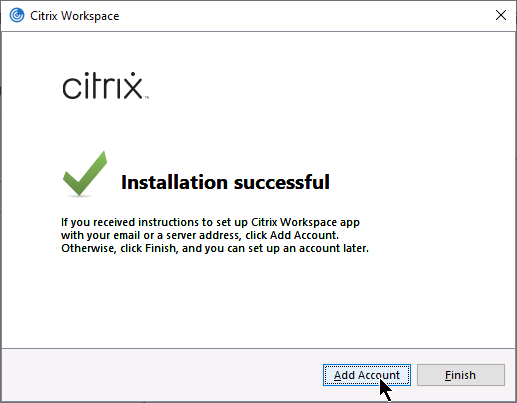

The Add Account wizard changed in Workspace app 2108 and newer. Enter a StoreFront FQDN, a Citrix Gateway FQDN, or Citrix Cloud Workspace FQDN. Only enter the FQDN. In that location's no demand to enter https or a path.


Workspace app will contact the FQDN and request download of the StoreFront Provisioning File.
- If you entered a StoreFront FQDN, and so Workspace app will download the Provisioning File directly from the StoreFront server.
- If you entered a Gateway FQDN, then Gateway will first prompt the user to cosign. Later authentication, Gateway will connect to its configured Account Services accost, and download the Provisioning File from StoreFront. The Account Services accost is configured in the NetScaler Gateway Session Profile on the Published Applications tab.

If your StoreFront server is configured with multiple stores, then the user will be prompted to select a store. Unfortunately, there'south no configuration pick in NetScaler Gateway to strength a particular store.

- One workaround is to hibernate the shop that you lot don't want visible externally. See How to configure Receiver to a Store that is not advertised for special syntax.

The Provisioning File downloaded from StoreFront is an XML document containing values for several items configured in the StoreFront console. Yous tin export the Provisioning File from the StoreFront console by right-clicking a Store.

The ReceiverConfig.cr Provisioning File looks something like this:

Here are the values in the Provisioning File:
Workspace app reads the Provisioning File, and configures itself by inserting the file's contents into the user's registry. The values are located under HKCU\Software\Citrix\Dazzle\Sites and HKCU\Software\Citrix\Receiver\SR. If you performed discovery through NetScaler Gateway, find that the internal Base URL is added to the user'south registry.

Once Workspace app is configured, information technology so performs the following steps:
- Endeavor to connect to the Internal Beacon.
- If the Internal Buoy is reachable, connect directly to the StoreFront Base URL (Accost).
- If the Internal Beacon is non reachable:
- Try to connect to the External Beacons. If the External Beacons are non reachable, then stop attempting to connect.
- Connect to the Gateway accost configured in the Provisioning File. If there is more than 1 Gateway, connect to the Gateway that is marked every bit the Default.
Here are some interesting notes on this connection process:
- The FQDN you entered during Discovery has absolutely nothing to do with how Workspace app connects to StoreFront or Gateway. The bodily connection process is controlled past the contents of the Provisioning File, not the Discovery accost.
- If the Provisioning File has multiple Gateways divers, Workspace app uses whichever Gateway is marked as Default. Workspace app and Receiver completely ignore whatever Gateway FQDN y'all entered during Discovery. To apply a not-default Gateway, the user must manually select the other Gateway in Workspace app'southward / Receiver's Advanced Preferences.

In StoreFront Panel, if any configuration changes are performed that affect the Provisioning File, do the Workspace apps / Receivers reconfigure themselves automatically? Or do users accept to remove Accounts and re-add (or Reset Citrix Workspace / Receiver) so the updated Provisioning File is imported?

Here are some additional methods of performing Workspace app Discovery:
Virtual Monitors
In Workspace app 1812 and newer, when continued to a published desktop on a unmarried monitor, y'all can split the screen into virtual monitors. This feature is intended for big 4K monitors.
Uninstall Old Clients
Workspace app and Receiver 4.4 and newer includes Receiver Clean-Up, then, in theory, it'south non necessary to uninstall former clients first. For more details, see Citrix CTX135933 Upgrading to Citrix Receiver for Windows.
- In Workspace app 1908 and older (including Receiver), to run it silently, run CitrixWorkspaceApp.exe /RCU /Silent orCitrixReceiver.exe /RCU /Silent.
- In Workspace app 1909 and newer, /forceinstall switch is the replacement for /rcu switch.
For a reliable upgrade experience, write a script to remove the one-time clients, make clean up the registry and file system, and so deploy the new Workspace app.
Citrix Blog Mail Cookbook to Upgrade from Receiver 3.iv for Windows to Receiver 4.2.100 and Citrix Commodity CTX135933 Upgrading to Citrix Receiver for Windows contains step-past-step procedure to use Group Policy to uninstall Receiver Enterprise 3.4 and install/configure Workspace app.
The Receiver Clean-Up utility for Receiver iv.3 and older is designed to assist with the post-obit scenarios:
- When errors occur during upgrade from an before version of Receiver, or Online Plug-in
- When unexpected behavior or performance is experienced after upgrade from an earlier Receiver or Online Plug-in
- If Receiver upgrade is non possible due to feature incompatibility and/or a clean uninstall is required
- The Receiver Clean-Upwards Utility removes components, files, and registry values of Online Plug-in xi.x, 12.x, and Receiver for Windows three.x, 4.ten (Online Plugin-in thirteen.10, fourteen.x). This includes the Offline Plug-in component if installed.
Citrix CTX325140: How to Remove Customer Files Remaining on System after Uninstalling Receiver for Windows.
Web log posts from Shaun Ritchie:
- PowerShell Script to Uninstall all Versions of Citrix Customer and Install Citrix Receiver 3.x
- Full list of Citrix Client Uninstall Strings
Installation and Configuration
This department contains a summary of all mutual control line switches, registry keys, and policy settings for Workspace app and Receiver.
Links:
- Citrix Weblog Post: Optimizing Citrix Receiver for Pre-launch and Single Sign-On
- Citrix CTX202002 How To Deploy Citrix Receiver for Windows Using SCCM 2012 R2
Workspace app 1912 CU5 and Workspace app 2105 and newer prepare security vulnerabilities.
CitrixWorkspaceApp.exe version 2202 (Electric current Release), or CitrixWorkspaceApp.exe version 1912 CU7 (aka nineteen.12.7000) (LTSR), can be installed by just double-clicking it. Annotation: LTSR 1912 does non support Browser Content Redirection. Workspace app 2006 and newer do not support Windows 7.


Administrator vs not-ambassador
- Non-administrator – If a non-administrator installs Workspace app, then each non-administrator that logs in to the same workstation will take to reinstall Workspace app.
- Not-administrator installations are installed to %USERPROFILE%\AppData\Local\Citrix\ICA Client for each user.
- Administrator – If CitrixWorkspaceApp.exe orCitrixReceiver. exe is installed using an administrator account. and so the Workspace app but needs to be installed once.
- Administrator installations are installed to C:\Program Files (x86)\Citrix\ICA Client.
- Administrator installations of Workspace app 1912 and newer can be manually upgraded by non-administrators by clicking Check for Updates. Older versions cannot be upgraded by non-administrators.
- Conflicts – If an administrator install of Workspace app is performed on a machine that has not-administrator installs of Workspace app, then the two installations will conflict. Best option is to uninstall non-admin Workspace app and Receiver before installing admin Workspace app. Otherwise, the user'southward profile probably has to exist reset before Workspace app is functional again.
- Citrix article CTX249920 Workspace App for Windows – Your apps are non bachelor at this time – Issue when installing Citrix Receiver in not elevated/per-user install manner describes the HKEY_CURRENT_USER registry keys that must be deleted to ready this issue.
- For a script to clean-upwardly the per-user installs, see Marking DePalma at Citrix Receiver Per-User Install Cleanup.
Machine-Update
Workspace app supports auto-update.

Some notes:
To troubleshoot Motorcar-update, see Citrix CTX226779 Troubleshooting Citrix Receiver Updates.

Motorcar-update is broken in Receiver for Windows 4.eleven and older, and Receiver for Mac 12.9 and older. To ready it, manually upgrade to the next version (due east.g. Workspace app for Mac), or install the Ready that can exist downloaded from the Receiver download page (Source = CTX234657 Receiver Updater stops working with "Problem Checking for updates" error)

Auto-update is configured using Workspace app group policy under the Citrix Workspace Updates,Receiver Updates or Auto-Update node.


Workspace app Splash Screen
Workspace app shows a Splash Screen on kickoff launch with the text "Citrix Workspace app extends the capabilities of Citrix Receiver".

To preclude this splash screen, set the following registry value: (source = Dennis Span on Twitter)
- Key = HKEY_CURRENT_USER\SOFTWARE\Citrix\Splashscreen
- Value (REG_SZ) =SplashscreenShown = 1

Add together Account Sorcerer
From Citrix CTX135438 How to Suppress the Add Account Window in Citrix Receiver for Windows: After installation, Workspace app will launch and inquire you to add an account. If Workspace app, notice the checkboxExercise not show this window automatically at logon.


For Workspace app and Receiver 4.4 and newer, FTU (Kickoff Time Use aka Add Account Wizard) volition be displayed only if a shop is not configured. If a store is already configured via command line, GPO, or Citrix Studio, and so FTU screen will not exist available later on installation. Otherwise, FTU can be suppressed by doing one of the following: (Annotation: Receiver 4.4.1000 and newer has a fix for preventing the Add Business relationship wizard)
- Rename CitrixReceiver.exe to CitrixReceiverWeb.exe.
- RenameCitrixWorkspaceApp.exe toCitrixWorkspaceAppWeb.exe.
- Install using a control line switch:
- CitrixWorkspaceApp.exe/ALLOWADDSTORE=North
- CitrixReceiver.exe/ALLOWADDSTORE=North
- Set the registry value: HKEY_LOCAL_MACHINE\SOFTWARE\Policies\Citrix\EnableFTU=dword:00000000 (or EnableX1FTU =dword:0)
- Disable the EnableFTU policy setting inReceiver.admx.

- Alter Registry values postal service installation to suppress the Add together Business relationship window. Under HKLM\Software\Wow6432Node\Citrix\Dazzle, set up AllowAddStore value to N.
- Set the registry value: HKEY_LOCAL_MACHINE\Software\Citrix\Receiver\NeverShowConfigurationWizard (REG_SZ) = true
- Also see Suppressing Add together Account dialog at Citrix Docs.
Discover Subconscious Stores
When Receiver is outset launched, it must perform Discovery, which is the process of downloading the .xml provisioning file from StoreFront. Discovery is performed by entering a StoreFront FQDN or Gateway FQDN. To discover a hidden store (a store that's not advertised), add ?StoreName to the terminate of the FQDN. CTX214819 How to configure Receiver to a Shop that is not advertised.
CitrixWorkspaceApp.exe / CitrixReceiver.exe Command line switches
CTX227370 Citrix Workspace app Commandline Tool contains a GUI tool to build your installer command line.
For unattended installation of Workspace app, encounter CTA Dennis Span Citrix Workspace App unattended installation with PowerShell or Citrix Receiver unattended installation with PowerShell.

Installer Command Line Switches are detailed at Configure and install Receiver for Windows using command-line parameters at Citrix Docs. Common Command line switches include the post-obit:
- /silent
- /includeSSON – enables pass-through authentication. GPO configuration is besides required as detailed below.
CitrixWorkspaceApp.exe /includeSSON CitrixReceiver.exe /includeSSON
- /ALLOWADDSTORE=A – past default, but SSL (HTTPS) stores are accepted. To allow not-SSL stores:
CitrixWorkspaceApp.exe /ALLOWADDSTORE=A CitrixReceiver.exe /ALLOWADDSTORE=A
- / STORE0 – To add a store from the installation command line:
CitrixWorkspaceApp.exe STORE0="AppStore;https://Citrix.corp.com/Citrix/MyStore/discovery;on;App Shop" CitrixReceiver.exe STORE0="AppStore;https://Citrix.corp.com/Citrix/MyStore/discovery;on;App Store"
- Workspace App and Receiver four.10 and newer tin can discover the Store through NetScaler Gateway.
CitrixWorkspaceApp.exe STORE0="AppStore;https://gateway.corp.com#MyStore;On;App Store" CitrixReceiver.exe STORE0="AppStore;https://gateway.corp.com#MyStore;On;App Shop"
- Workspace App and Receiver four.10 and newer tin can discover the Store through NetScaler Gateway.
- /SELFSERVICEMODE=False – disables the Self-Service interface and enables shortcut-only mode:
CitrixWorkspaceApp.exe /SELFSERVICEMODE=False CitrixReceiver.exe /SELFSERVICEMODE=False
- /AutoUpdateCheck=machine /AutoUpdateStream=LTSR – enables Citrix Workspace (or Receiver) Update notifications and sets it to LTSR Branch only. AutoUpdateCheck can also be set to manual or disabled. AutoUpdateStream can likewise be gear up to Current. Run across Configuring Citrix Workspace Updates at Citrix Docs.
CitrixWorkspaceApp.exe /AutoUpdateCheck=motorcar /AutoUpdateStream=LTSR CitrixReceiver.exe /AutoUpdateCheck=machine /AutoUpdateStream=LTSR
- /ENABLEPRELAUNCH=True – enables prelaunch:
CitrixWorkspaceApp.exe /ENABLEPRELAUNCH=True CitrixReceiver.exe /ENABLEPRELAUNCH=True
- /ALLOW_CLIENTHOSTEDAPPSURL=i – enables Local App Access:
CitrixWorkspaceApp.exe /ALLOW_CLIENTHOSTEDAPPSURL=ane CitrixReceiver.exe /ALLOW_CLIENTHOSTEDAPPSURL=1
Registry values
HKLM\Software\Wow6432Node\Citrix\Dazzle on the Workspace app machine. All are of blazon REG_SZ (string) unless specified. Note: several of these are configurable using the Reciever.admx group policy template.
- SelfServiceMode (REG_SZ) = False – Turns off Workspace app's / Receiver'southward Cocky-Service interface.
- PutShortcutsOnDesktop (REG_SZ) = True – If Cocky-Service interface is disabled, places all shortcuts on desktop.
- UseDifferentPathsforStartmenuAndDesktop (REG_SZ) = True
- UseCategoryAsStartMenuPath (REG_SZ) = True or False
- UseCategoryAsDesktopPath (REG_SZ) = True or False
- StartMenuDir (REG_SZ) = name of binder on Kickoff Menu where shortcuts are placed.
- DesktopDir (REG_SZ) = proper noun of folder on Desktop where shortcuts are placed
- EnablePreLaunch (REG_SZ) = True – If SSON is enabled then PreLaunch is already enabled by default.
- AllowAddStore (REG_SZ) = A – Only if using http (instead of https) to connect to StoreFront.
- AllowSavePwd (REG_SZ) = A – Only if using http (instead of https) to connect to StoreFront.
- UserDomainName (REG_SZ) = pre-filled domain name
- InitialRefreshMinMs (REG_SZ) = 1 – minimizes the launch delay earlier contacting shop
- InitialRefreshMaxMs (REG_SZ) = i – minimizes the launch delay earlier contacting shop
- RefreshMs (REG_SZ) = 3600000 (1 hr) – interval for Receiver icon refreshes. 1 hr is the default value.
- RefreshMs (REG_SZ) = 18000000 – Citrix CTX213755 Citrix Receiver Shows Authentication Window Periodically When Receiver is Non Opened
- MaxSimultaneousFetches (REG_DWORD) = 6 – improves the time of loading icons in Start Bill of fare
- MaxSimultaneousSubscribes (REG_DWORD) = half dozen – improves the time of loading icons in Start Card
- DontWarnOfRemovedResources (REG_SZ) = True – prevents dialog boxes when resources are removed from the server. (or Fake equally mentioned at Citrix Discussions?)
- SilentlyUninstallRemovedResources (REG_SZ) = True – prevents dialog boxes when resources are removed from the server
- PreferTemplateDirectory (REG_SZ) = UNC path or local path containing shortcuts copied by the prefer keyword. Give the shortcuts a short proper noun.
- PnaSSONEnabled (REG_SZ) = Truthful – Enables Single Sign-on for PNAgent (Web Interface).
- WSCReconnectMode (REG_SZ) = 3 (default) – If this Workspace app is running inside a VDA published desktop, set up it to 0.
- If you're having trouble getting sessions to reconnect, see Receiver iv.3 Desktop volition not automobile-reconnect when logging into a motorcar at Citrix Discussions
- AlwaysUseStubs (REG_SZ) = Truthful. Workspace app and Receiver 4.3.100 and newer don't create .exe stubs by default. Set this to create .exe stubs. Also run across Citrix CTX211893 Controlling Shortcut behavior in Receiver 4.3.100.
- DontCreateAddRemoveEntry (REG_SZ) = True – don't create "Delivered by Citrix" entries in Programs and Features
- DesktopNameFormatString = format cord for shortcut names – For example "{0}_{one}_{2}_{iii}". See the link for details.
- SelfServiceFlags (REG_DWORD) = 4 – prevents duplicate shortcuts when roaming and Desktop is redirected.
- SelfServiceFlags = 5 to stop external SSON from prompting for authentication
- ReEvaluateNetwork (REG_SZ) = true – for Beacon detection with Single FQDN
To prevent the Win+1000 popup on Windows 10 machines:
- HKEY_LOCAL_MACHINE\SOFTWARE\Policies\Microsoft\Windows\GameDVR
- AllowGameDVR (REG_DWORD) = 0
To permit calculation non-HTTPS stores to Workspace app:
- HKLM\Software\Wow6432Node\Citrix\AuthManager
- ConnectionSecurityMode (REG_SZ) = Any
To increase ICA bandwidth consumption over high latency links, fix:
- HKEY_LOCAL_MACHINE\SOFTWARE\Wow6432Node\Citrix\ICA Customer\Engine\Configuration\Avant-garde\Modules\TCP/IP
- OutBufCountClient2 = Number of OutBufs (default is 44)
- OutBufCountHost2 = Number of OutBufs (default is 44)
- Meet CTX125027 How to Optimize HDX Bandwidth Over High Latency Connections for some recommended values (multiples of 44)
To prevent beacon probing from using proxy, set:
- HKEY_LOCAL_MACHINE\Software\WOW6432Node\Citrix\Receiver\inventory
- BeaconProxyEnabled (REG_DWORD) = 0
To enable foreground progress bar, set:
- HKEY_LOCAL_MACHINE\SOFTWARE\Wow6432Node\Citrix\ICA Customer
- ForegroundProgressBar (REG_DWORD) = 1
For customer-to-server file type redirection, set:
- HKEY_LOCAL_MACHINE\SOFTWARE\Wow6432Node\Citrix\ICA Client\Engine\Configuration\Advanced\Modules\ClientDrive
- NativeDriveMapping="Truthful"
To gear up USB devices that emulate a keyboard, set:
- HKEY_LOCAL_MACHINE\SOFTWARE\Wow6432Node\Citrix\ICA Client\Engine\Lockdown Profiles\All Regions\Lockdown\Virtual Channels\Keyboard
- KeyboardTimer="10"
To prevent "USB Hub Power Exceeded" message, set (not needed in iv.ii.100 and newer):
- HKLM\SOFTWARE\Citrix\ICA Client\GenericUSB (same path for 32-bit and 64-bit, create the keys)
- DisableInternalDeviceCtlDispatchHook (DWORD) = 0x1
To override the devices that are mapped using optimized channels instead of generic USB, run into Citrix CTX123015 How to Configure Automated Redirection of USB Devices
Group Policy Settings
Copy the Workspace app ADMX template (C:\Program Files (x86)\Citrix\ICA Customer\Configuration\receiver.admx) to C:\Windows\PolicyDefinitions (or Sysvol). Too copy receiver.adml to C:\Windows\PolicyDefinitions\en-usa (or Sysvol).
Edit a GPO that applies to client machines, get to Calculator Configuration | Policies | Administrative Templates | Citrix Components | Citrix Workspace (or Receiver) and configure the following:
- To enable pass-through authentication: go to | User Authentication |.
- Local Username and Password – Check the meridian two boxes.
- Also add the StoreFront FQDN to the Local Intranet zone in Cyberspace Explorer.
- Single Sign-on for NetScaler Gateway (Workspace app 1808 and newer)
- To add together a store, go to | StoreFront |
- StoreFront Accounts List – run into the help text
- To enable Machine-Update, get to|AutoUpdate| or|Receiver Updates| or|Citrix Workspace Updates|. (the node was renamed in 4.11 and Workspace app)
- Enable or Disable AutoUpdate or
- Receiver Updates or
- Citrix Workspace Updates
- To enable Local App Access, go to | User Experience |
- Local App Access Settings
- To configure the Self-Service interface, become to | SelfService |
- Set Manage SelfServiceMode to Disabled to completely disable the Self-Service window. This causes all icons to exist placed on the Beginning Carte.
- Enable Manage App Shortcut and configure it as desired.
- To allow the Cocky-Service window, just forbid it from automatically opening (reside in systray), tickForestall Citrix Workspace (or Receiver) performing a refresh of the application list when opened. Source
- Enable Command when Workspace (or Receiver) attempts to reconnect to existing sessions. If this is a VDA published desktop, gear up it to Disabled. Otherwise configure it as desired.
- Set Enable FTU to Disabled to preclude the Add Account sorcerer from displaying.
- EnableAllow/Prevent users to publish unsafe content if publishing content that's opens a file or file share.
Enable automated customer drive and customer microphone mapping.
- In a client-side GPO, add together the GPO ADM template from http://support.citrix.com/commodity/CTX133565.
- Enable the setting Create Client Selective Trust Keys. Run across Below for details.
- Configure the FileSecurityPermission setting in ane or more of the regions.
- Configure the MicrophoneAndWebcamSecurityPermission setting in one or more of the regions.
Citrix CTX203658 Starting time Carte Icons Set up to Default (Bare Document) After Update to Receiver 4.3.100 – Windows eight and newer
- Computer Configuration | Policies | Administrative Templates | Windows Components | File Explorer
- Permit the employ of remote paths in file shortcut icons = enabled
Deploy Workspace app using Active Directory
To deploy Workspace app using Agile Directory, configure a GPO with a computer startup script that runs the Workspace app installer executable. Citrix provides sample scripts that can be downloaded from one of the Workspace app download pages (Workspace app version 2202 (Electric current Release), or Workspace app version 1912 CU7 (aka nineteen.12.7000) (LTSR), by expanding Downloads for Admins (Deployment Tools).

Also run across CTA Dennis Bridge Citrix Receiver unattended installation with PowerShell.

Modify Workspace App'southward Shop Configuration, including Reset Citrix Workspace / Receiver
Yous can change Workspace app's / Receiver'southward configured Shop/Account with a couple control lines:
"C:\Program Files (x86)\Citrix\ICA Client\SelfServicePlugin\SelfService.exe" -deleteproviderbyname Corporate "C:\Program Files (x86)\Citrix\ICA Customer\SelfServicePlugin\SelfService.exe" -init -createprovider Corporate https://storefront.corp.com/Citrix/Store/discovery
Information technology is sometimes necessary toReset Citrix Workspace orReset Receiver by right-clicking the Workspace app systray icon, clickingAdvanced Preferences, and clicking theReset link. You tin can do this from the command line by running "C:\Plan Files (x86)\Citrix\ICA Customer\SelfServicePlugin\CleanUp.exe" -cleanUser -silent. See CTX140149 How to Reset Receiver Using the Control Line.


Receiver for Edge
The Receiver for Spider web experience in Microsoft Edge is not ideal. Every time a user clicks an icon, the user has the click theOpen button afterward the .ica file is downloaded.

Citrix Weblog Mail service Providing Full Receiver for Web Feel for Microsoft Edge has instructions for enabling the Receiver Launcher for Border. Use your preferred text editor to open web.config for the RfWeb site yous would similar to configure (typically C:\inetpub\wwwroot\Citrix\StoreWeb\spider web.config). Locate the line like this: <protocolHandler enabled="true" platforms="(Macintosh|Windows NT).*((Firefox/((5[3-9]|[6789][0-nine])|\d\d\d))|(Chrome/((4[2-ix]|[56789][0-9])|\d\d\d)))(?!.*Edge)". Remove (?!.*Border) and save the file.
Simply once you practise that, yous get a new switch apps prompt every fourth dimension you launch an icon from Edge.

To terminate theswitch apps pop-upward, on the client side, edit the registry, go to
HKEY_LOCAL_MACHINE\SOFTWARE\Microsoft\Internet Explorer\ProtocolExecute\receiver (create missing registry keys), create DWORD valueWarnOnOpen, and fix information technology to 0 (zero). You can use Group Policy Preferences to deploy this registry value.

Workspace app Group Policy ADMX Template
Many of the Workspace app configuration settings must be configured in group policy. These Workspace app settings are simply bachelor later on installing the GPO templates.
- From a auto that has Workspace app installed, notice the .admx and .adml files in the C:\Plan Files (x86)\Citrix\ICA Client\Configuration.
- You can also download the ADMX files from 1 of the Workspace app download pages (Workspace app version 2202 (Current Release), or Workspace app version 1912 CU7 (aka 19.12.7000) (LTSR), by expanding Downloads for Admins (Deployment Tools).

- You can also download the ADMX files from 1 of the Workspace app download pages (Workspace app version 2202 (Current Release), or Workspace app version 1912 CU7 (aka 19.12.7000) (LTSR), by expanding Downloads for Admins (Deployment Tools).
- Copy theCitrixBase.admx andreceiver.admx files. Too copy theen-U.s. folder. In Workspace app, the files are still namedreceiver.admx.

- Go to your domain'due south SYSVOL share and in the Policies folder look for a PolicyDefinitions folder. If 1 exists, paste the .admx file directly into the PolicyDefinitions folder. If this folder doesn't exist in SYSVOL, instead copy the .admx file to C:\Windows\PolicyDefinitions. Overwrite any existing Receiver ADMX files.

- The GPO settings can then be establish at one of the following:
- Computer Configuration > Policies > Authoritative Templates > Citrix Components > Citrix Workspace
- Computer Configuration > Policies > Authoritative Templates > Citrix Components > Citrix Receiver
- For instance, y'all can disable Customer Feel Comeback Program (CEIP) from here.
- Run across https://www.carlstalhood.com/commitment-controller-cr-and-licensing/#ceip for additional places where CEIP is enabled.

- Workspace app 1905 and newer has a setting toDisable sending data to 3rd political party (eastward.g. Google Analytics).

- Workspace app 1905 and newer permit you disable embedded browser caching.

- Workspace app 1905 and newer accept NetScaler LAN Proxy underNetwork routing > Proxy.

- Workspace app 1808 and newer haveUser hallmark |Single Sign-on for NetScaler Gateway.

- Receiver iv.12 adds Network Routing | Deprecated cipher suites to configure deprecated ciphers.


- Citrix Workspace Updates, (akaAutoUpdate) tin can be configured using group policy. See Configuring Citrix Workspace Updates at Citrix Docs.

- Workspace app 1912 and newer can exist configured to require in-memory ICA files only. The setting called Secure ICA file session launch is under the Client Engine node. Meet Citrix Docs for details on in-retentivity ICA files instead of writing ICA files to disk.

- Workspace app has settings to hide Avant-garde Preferences, enable/disable DPI, and enable/disable H265.

- Workspace app 4.8 and newer take SplitDevices GPO setting underCitrix Workspace | Remoting client devices | Generic USB Remoting. Run across Configuring composite USB device redirection at Citrix Docs.

Pass-through Authentication
Citrix blog post – A Comprehensive Guide to Enabling Pass-Through Authentication with XenDesktop 7.5
- Run the command
Set-BrokerSite -TrustRequestsSentToTheXmlServicePort $True from a Windows PowerShell command prompt on a Delivery Controller.

- In XenApp 6.5, this is a Citrix Policy > Figurer > Trust XML Requests.
- Login to the PC as an administrator.
- If installing Workspace app, as an administrator, during installation, on the Enable Single Sign-on page, check the box next to Enable Unmarried Sign-on. Then end the installation.


- If installing an older version of Receiver:
- Get to the downloaded Citrix Receiver. Shift-right-click CitrixReceiver. exe, and click Copy as path.

- Open up a command prompt.
- Correct-click to paste the path in the command prompt and so add /includeSSON to the end of the command. Press <Enter>.

- Click Install when prompted.

- Get to the downloaded Citrix Receiver. Shift-right-click CitrixReceiver. exe, and click Copy as path.
- To verify that SSON is installed, go to C:\Program Files (x86)\Citrix\ICA Client and expect for the file ssonsvr. exe.

- And if y'all open regedit and go to HKLM\Arrangement\CurrentControlSet\Control\NetworkProvider\Lodge, you should see PnSson in the ProviderOrder.

- Install the receiver.admx (and .adml) template into PolicyDefinitions if yous haven't already.
- Edit a GPO that is applied to the client PCs where the Workspace app is installed.
- Go to Computer Configuration > Policies > Administrative Templates > Citrix Components > Citrix Workspace.
- Expand Citrix Workspace and click User authentication.
- On the correct, double-click Local user proper noun and countersign.

- Select Enabled and then check the box side by side to Allow pass-through hallmark for all ICA connections. Click OK.

- In Workspace app 1808 and newer, yous can enableUnmarried Sign-on for NetScaler Gateway.

- Ensure that the internal StoreFront FQDN is in the Local Intranet zone in Cyberspace Explorer. You lot tin apply a GPO to configure this on the customer side.

- Local Intranet zone should have Automatic logon merely in Intranet zone enabled.

- Logoff Windows and log back on. In Task Manager you should at present see ssonsvr. exe. This won't appear unless you logoff and log back on.

- If Workspace app won't connect or is tedious to enumerate icons, then you might have to disable Automatically detect settings in IE.

- Correct-click the Workspace app icon and click Avant-garde Preferences.

- ClickConfiguration Checker.

- Check the box next toSSONChecker and clickRun.

- The lines with red x will bespeak the result and corrective activeness.

StoreFront Accounts
Yous can use a customer-side GPO to add a store (Business relationship) to Workspace app Self-Service.
- Install the receiver.admx (and .adml) template into PolicyDefinitions if you oasis't already.
- Edit a GPO that applies to endpoint devices that have Citrix Workspace app installed.
- Go to Reckoner Configuration > Administrative Templates > Policies > Citrix Components > Citrix Workspace > StoreFront.
- On the correct, double-click NetScaler Gateway URL/StoreFront Accounts List.

- Select Enabled, and then clickBear witness.

- Enter a store path based on the case shown in the Aid box. Workspace app lets you enter a Gateway path. And so click OK.
- Note: Gateway paths work in GPO, but might not work when specified in the CitrixWorkspaceApp.exe installation command line.


Published Shortcuts and Reconnect
Citrix CTX200924 How to Customize App Shortcuts with Receiver for Windows
Workspace app has a user interface for setting Shortcut Paths. Right-click the Workspace app systray icon, click Advanced Preferences, and then clickShortcuts and Reconnect, orSettings Option.


From Citrix Docs Configuring application delivery: At that place are several methods of decision-making how Workspace app displays shortcuts on the Start Bill of fare and Desktop as detailed below:
- Workspace app Registry values
- receiver.admx GPO Template
- From StoreFront in C:\inetpub\wwwroot\Citrix\Roaming\web.config
- Published App Keywords (east.g. adopt).
- Workspace app and Receiver four.2.100 and newer supports published app Delivery configuration for adding the shortcut to the desktop. This only works if the app is a Favorite, or if Favorites are disabled, or Mandatory Store.

Nether HKLM\Software\Wow6432Node\Citrix\Dazzle (or HKCU\Software\Wow6432Node\Citrix\Dazzle) are several registry values related to shortcuts. Some of the settings only apply if SelfServiceMode is set to Faux. Here are some mutual options:
- SelfServiceMode – set to Simulated then Receiver disables the Cocky-Service interface and automatically places all published shortcuts on the Start Menu and/or Desktop. More than details in Configuring application delivery at Citrix Docs.
- PutShortcutsOnDesktop– set toTruthful to place every app on the desktop
- DesktopDir – Workspace app places every shortcut on the desktop so information technology'south probably all-time to place them in a folder.
- StartMenuDir – If at that place is potentially a conflict between local apps and remote apps, then you lot should place the Start Menu shortcuts in a binder.
- PreferTemplateDirectory (with KEYWORDS:prefer=shortcutname) – copies the shortcutname from the template directory to the Start Menu and/or Desktop.

If yous import the receiver.admx (and .adml) into the PolicyDefinitions folder, under Calculator Configuration > Administrative Templates > Citrix Components > Citrix Workspace (or Receiver) is a node called SelfService.

Disable the Manage SelfServiceMode setting to hide the Workspace app Window.

Enable the Manage App shortcut setting to control placement of shortcuts.

Workspace app and Receiver 4.two.100 and newer have the power to configure (or disable) Workspace Control using group policy. Enable the setting Control when Citrix Workspace attempts to reconnect to existing sessions and configure it equally desired.


Prelaunch
Staring with Receiver four.ii, prelaunch is automatically enabled if Workspace app is installed with SSON enabled. Otherwise, set registry values to enable prelaunch. Receiver 4.2.100 prevents the prelaunch icon from appearing on the Start Menu.
- HKLM\Software\[Wow6432Node\]Citrix\Dazzle
- EnablePreLaunch (REG_SZ) = truthful or faux

Boosted customizations can be configured at:
HKEY_LOCAL_MACHINE\SOFTWARE\Wow6432Node\Citrix\ICA Client\Prelaunch
- Name: State
- REG_SZ: 0 = disable, 1 = but-in-time pre-launch, 2 = scheduled pre-launch
- Proper noun: Schedule
- REG_SZ: HH:MM|Grand:T:West:TH:F:South:SU where HH and MM are hours and minutes. M:T:West:TH:F:S:SU are the days of the calendar week. For example, to enable scheduled pre-launch on Monday, Wednesday, and Friday at ane:45 p.m., ready Schedule as Schedule=13:45|1:0:i:0:one:0:0 . The session actually launches between 1:xv p.yard. and one:45 p.m.
- Name: UserOverride
- REG_SZ: 0 = HKLM overrides HKCU, ane = HKCU overrides HKLM
Device Access Beliefs (Client Selective Trust)
When connecting to a XenApp/XenDesktop session, you might come across the following:


To configure the default behavior, see the Citrix Knowledgebase commodity How to Configure Default Device Admission Beliefs of Receiver, XenDesktop and XenApp. Notation: at that place is a bug fixed in Receiver 4.two.100 and newer.
- Download the ADMX file from http://support.citrix.com/article/CTX133565.

- Copy the .admx and .adml files to PolicyDefinitions (Sysvol, or C:\Windows).
- The.adml file goes in theen-Usa folder.

- Edit a GPO that applies to the endpoint devices that are running Receiver.
- Go to Computer Configuration | Policies | Administrative Templates | Citrix Components | Citrix Workspace (or Receiver) |Citrix Client Selective Trust (x64).
- Enable the setting Create Customer Selective Trust Keys.


- Then expand the regions, and configure the permission settings as desired.


Desktop Lock
Every bit an culling to Workspace app Desktop Lock, run across Transformer in Citrix Workspace Environment Manager.

External links:
- Dale Scriven YouTube video – Citrix Desktop Lock installation and configuration
- Jarian Gibson and Andrew Morgan – Citrix Receiver Desktop Lock
- An alternative to Desktop Lock – ThinKiosk
Use Studio to configure Workspace app Accounts in Published Desktop
In published desktops, Workspace app can be used for placement of shortcuts on the user's Get-go Bill of fare and Desktop. Use group policy to hide the mutual plan groups and so utilise Workspace app to identify published applications back on the Start Bill of fare and Desktop based on user'southward group membership and subscription preference.
- In Citrix Studio, on the left, expand the Configuration node, right-click StoreFront and click Add StoreFront.

- Enter a descriptive name for the StoreFront server.
- Enter the internal https URL of the load counterbalanced StoreFront servers. Add together the path to your store (due east.g. /Citrix/Shop) and and then /discovery on the end of the URL. The full URL would be similar to https://citrix.corp.com/Citrix/Store/discovery. Click OK.

- Edit a Delivery Group that has a published desktop and Citrix Workspace app installed.

- On the StoreFront page, modify the choice to Automatically, using the StoreFront servers selected below, and then check the box side by side to the StoreFront URL. Click OK. Now when users launch the published desktop, Workspace app will be automatically configured with this URL.

Published Desktop – use Workspace app to control Shortcuts
If you install Workspace app inside a published desktop (Workspace app on a VDA), then Workspace app can get icons from StoreFront and put those icons on the user's published desktop First Menu and Desktop. This is an alternative to using a User Feel Management product to control shortcut placement.

Note: Workspace app tends to be slow to create Start Menu shortcuts, so make certain you perform a Proof of Concept to make up one's mind how this functionality impacts logon times.
Configuration of Workspace app inside a published desktop is simplified if you lot have the following minimum versions:
- Workspace app installed within the VDA
- VDA seven.17 or newer
- StoreFront 3.14 or newer
If you run across these minimum version requirements, then Workspace app installed in the VDA automatically tries to launch published applications on the same local VDA rather than trying to launch them from a different VDA (aka double-hop). This characteristic is called vPrefer.
- If you don't meet these minimum version requirements, then you lot'll need to use the older Prefer Keyword method of handling Workspace app shortcuts as detailed later.
- For a detailed caption of vPrefer, run across Citrix Weblog Post VPrefer: Session Sharing Between a Published Desktop and a Published Awarding Made Easy

Practice the following for all versions of Workspace app, VDA, and StoreFront, whether using the Prefer keyword or not:
- Make sure Workspace app or Receiver version iv.11 or newer is installed on the VDA.
- Install the Workspace app ADMX files if you haven't already. For vPrefer, make sure they are the ADMX files from Workspace app.
- Enable the Group Policy settingRemove common program groups from Start Bill of fare and apply it to non-administrators.
- This removes all Public (aka All Users) Start Menu shortcuts. Workspace app will re-add together the shortcuts based on user group membership.
- On the VDA, configure the following Workspace app Registry keys (or corresponding settings in the receiver.admx GPO template):
- HKEY_LOCAL_MACHINE\SOFTWARE\Wow6432Node\Citrix\Dazzle\WSCReconnectMode="0″ then Workspace app doesn't effort to reconnect to the published desktop you're already running.
- HKEY_LOCAL_MACHINE\SOFTWARE\Wow6432Node\Citrix\Dazzle\SelfServiceMode to False. This turns off the Workspace app Cocky-Service GUI and acts like all icons are subscribed. Otherwise, only subscribed (favorited) icons would be placed on the Start Menu and Desktop.
- HKEY_LOCAL_MACHINE\SOFTWARE\Wow6432Node\Citrix\Dazzle\UseCategoryAsStartMenuPath = True. This creates a Start Menu binder based on the published app'southward configured Category.

- Configure each desired published app to Add shortcut to user's desktop.

- Or, configure HKEY_LOCAL_MACHINE\SOFTWARE\Wow6432Node\Citrix\Dazzle\PutShortcutsOnDesktop = Truthful to place all icons on the desktop.
- To control icon placement, configure the following registry values:
- HKEY_LOCAL_MACHINE\SOFTWARE\Wow6432Node\Citrix\Dazzle\StartMenuDir to identify published applications in a sub-folder. Notation: Windows Server 2012 and Windows ten and newer but supports a single level of Starting time Carte folders, so setting this effectively turns off published app categories.
- HKEY_LOCAL_MACHINE\SOFTWARE\Wow6432Node\Citrix\Dazzle\DesktopDir to place published applications in a sub-binder on the desktop.
- Pass-through authentication:
- In a GPO that applies to the VDA, import the receiver.admx file, and fix Local user name and password to Enabled. Check the box next to Allow laissez passer-through hallmark for all ICA connections.
- If you're using Gateway internally, and if Workspace app 1808 or newer, then likewise enableSingle Sign-on for NetScaler Gateway.
- In a user-level GPO that applies to the VDA, add together the StoreFront FQDN to the Local Intranet zone. Make sure it is non in the Trusted Sites zone, or enable Automatic logon with current user proper noun and password for the Trusted Sites zone.
- Brand sure ssonsvr. exe is running after you login to the VDA. If not, troubleshoot information technology.
- When configuring Citrix Profile Management, make sure !ctx_startmenu! is not excluded from roaming.
- In Citrix Studio, configure a Delivery Group with commitment blazon = Desktop and Applications. Assign users to the delivery group, and the private published applications (if visibility is limited).
- In Citrix Studio, edit each published application, and on the Commitment tab, specify a category. This volition get the Offset Card folder proper name.
- If Workspace app Self Service Mode (GUI) is enabled, in Studio, edit each awarding, and add KEYWORDS:Automobile and/or KEYWORDS:Mandatory to the published application description. This forces the applications to be subscribed/favorited. Only subscribed (or Favorite) apps are displayed in the Offset Menu and Desktop. Unless y'all disable Workspace app's SelfService interface every bit described earlier.
- Another selection is to become to the StoreFront Panel, click Stores on the left, and on the correct, click Configure Store Settings, and click Disable User Subscriptions. This causes all apps to announced on the Start Menu and/or Desktop depending on Workspace app configuration.
- Create a group policy that applies to VDAs, and configure the grouping policy to ascertain the Store URL for Workspace app similar to https://citrix.corp.com/Citrix/Store/discovery. Replace the FQDN with your load counterbalanced StoreFront FQDN. Also supersede the path to the store with your store path. Make sure there is /discovery on the end. By default, Workspace app and Receiver merely back uphttps.
- Your StoreFront shop probably delivers both awarding and desktop icons. If you want to filter out the desktop icons, so create a new StoreFront store, and configure the Workspace app on the VDA to connect to the new Store.
- In StoreFront Panel, click the store for VDAs, and click Configure Store Settings. On the Advanced Settings page, in the Filter resources past type row, choose Citrix.MPS.Desktop.

- For vPrefer in Workspace app, VDA 7.17 (or newer), and StoreFront 3.14 (or newer), edit a GPO that applies to the VDAs.
- Go to Calculator Configuration | Policies | Administrative Templates | Citrix Components | Citrix Workspace (or Receiver) | SelfService.
- Edit the settingvPrefer. This setting is merely in Workspace app ADMX templates from Workspace app.
- Ready it toAllow all apps. Source = 7.17 vPrefer – not working with 32Bit Apps at Citrix Discussions.

- On your Commitment Controller, in PowerShell, run prepare-brokersite -TrustRequestsSentToTheXmlServicePort $true
- This is required for Laissez passer-through Authentication from Workspace app.
- Configure your customer devices to connect to the published desktop.
- When users connect to the published desktop, Workspace app volition auto-launch and hopefully auto-login.
- If Workspace app Self-Service Mode is disabled, all published applications should automatically appear in the Start Menu and Desktop.
- If Workspace app Cocky-Service Mode is enabled, and then only applications with KEYWORDS:Car and/or KEYWORDS:Mandatory in the published application description volition be displayed. Users can open up the systray icon to subscribe to more applications.
- Users can copy icons from the Start Menu to the desktop. Brand certain the user Copies the icon and doesn't Movementinformation technology.
- Users tin can and then launch applications straight from the Start Menu, from the Desktop, or from the Workspace app (if the Self-Service interface is enabled).
- If Workspace app iv.11 (or newer), VDA 7.17 (or newer), and StoreFront 3.fourteen (or newer), thenvPrefer is enabled by default. When launching an app icon that came from Workspace app, Workspace app checks the local VDA auto to see if the application can be launched on the local VDA instead of by creating a new Citrix double-hop session.
- If the awarding is installed locally on the VDA then the local application shortcut should launch chop-chop. If the application is on a different delivery group and then a 2nd (double-hop) Citrix HDX/ICA connexion volition be established.
- If the user deletes Workspace app shortcuts from the Commencement Menu, you can become them back past going to the systray icon and refreshing the applications. Or sometimes you have to reset Workspace app.
If you are running components older than Receiver 4.11, VDA 7.17, and StoreFront 3.14, then y'all'll need to configure theprefer keyword to get Receiver delivered icons to launch on the local VDA instead of in a new double-hop Citrix connection.
- Enable the Group Policy settingRemove mutual programme groups from Outset Carte and apply it to non-administrators.
- For applications that are installed on the same VDA that is publishing the desktop, configure Grouping Policy Preferences to recreate the application shortcuts based on Agile Directory grouping membership. Applications on other delivery groups are handled by Receiver.
- Or utilise the prefer keyword to copy shortcuts from the PreferTemplateDirectory.
- On the VDA, configure the following Receiver Registry keys (or corresponding settings in the receiver.admx GPO template):
- HKEY_LOCAL_MACHINE\SOFTWARE\Wow6432Node\Citrix\Dazzle\PreferTemplateDirectory = a UNC path or local path containing shortcuts to be copied past the adopt keyword. This tin point to C:\ProgramData\Microsoft\Windows\Get-go Menu.
- In Citrix Studio, configure a Commitment Group with commitment type = Desktop and Applications. Assign users to the Delivery Grouping and the applications (if visibility is limited).
- In Studio, edit each application and change KEYWORDS:Prefer to KEYWORDS:prefer. Notice the lower instance p. It doesn't work with capital P.
- With the prefer keyword, if you publish an application that is besides created using Group Policy Preferences, the Group Policy Preferences icon will take precedence. This is good. Otherwise the Receiver published awarding icon would result in a new Citrix double-hop session.
- See Ralph Jansen Citrix Receiver 4.1 Adopt keyword examples
- If using the prefer keyword with the PreferTemplateDirectory, enter it as KEYWORDS:prefer=shortcutname where shortcutname is the proper name of the shortcut that is copied from the Template directory.
- In Studio, edit each application and change KEYWORDS:Prefer to KEYWORDS:prefer. Notice the lower instance p. It doesn't work with capital P.
- Configure your client devices to connect to the published desktop.
- When users connect to the published desktop, Group Policy Preferences will create shortcuts to local applications.
- Receiver will auto-launch and hopefully auto-login.
- If Receiver Cocky-Service Way is disabled, all published applications should automatically appear in the Start Menu and Desktop.
- If Receiver Cocky-Service Mode is enabled and so only applications with KEYWORDS:Auto and/or KEYWORDS:Mandatory in the published application clarification will be displayed. Users tin can open the systray icon to subscribe to more applications.
- For published applications with KEYWORDS:prefer=shortcutname, Receiver should copy icons from the template directory to the Start Bill of fare and/or Desktop. See below for considerations.
- Users can copy icons from the Start Menu to the desktop. Brand sure the user Copies the icon and doesn't Moveit.
- Users can then launch applications straight from the Commencement Bill of fare, from the Desktop, or from the Receiver (if Self-Service interface is enabled).
- If a local shortcut (e.thou. Group Policy Preferences shortcut, or copied from template directory) matches a published awarding withKEYWORDS:adopt and then the local shortcut will override the published application icon.
- If the application is installed locally on the VDA and then the local awarding shortcut should launch chop-chop. If the awarding is on a different delivery group so a second (double-hop) Citrix HDX/ICA connection will be established.
- If the user deletes Receiver shortcuts from the Outset Carte du jour, you lot can get them back past going to the systray icon and refreshing the applications. Or sometimes you have to reset Receiver.
Notes regarding Prefer Template Directory
- Prefer Template Directory tin point toC:\ProgramData\Microsoft\Windows\Start Bill of fare, which is the All Users Beginning Carte du jour.
- The shortcuts copied from the Prefer Template Directory are renamed to match the published app name.
- For prefer local apps, any command line parameters specified in the published app are ignored. If you need these control line parameters, add together them to the shortcut in the Adopt Template Directory.
- If y'all have multiple published apps pointing to the same prefer local shortcut, and then only one copy will exist made, and it will have the name of only 1 of the published apps. To workaround this, in the Adopt Template Directory, create separate shortcuts for each published app, and conform the published app prefer keyword accordingly.
- Jan Hendrik Meier Automatic Shortcut generation for local installed applications in a Citrix XenDesktop / XenApp 7.x environment has a script that tin can create shortcuts based on the published apps withadopt keyword. These shortcuts can so be copied to your Prefer Template Directory.
How to Script/Automate Workspace app and Receiver Cocky-Service
From Citrix Knowledgebase article Driving the Citrix Receiver Self-Service Plug-in Programmatically: by default, Workspace app Self-Service (SSP) activities are driven by user interaction. However, SSP exposes sufficient information for its activities to exist scripted.
When SSP builds a shortcut, it builds it to a small-scale stub application in a file %appdata%\Citrix\SelfService\app-name-with-spaces-removed.exe for each resource. These files allow SSP to create a fake 'install' record for Add/Remove Software. Running these .exe files causes the application to launch. Note: Workspace app and Receiver 4.iii.100 and newer don't create stubs by default. To enable, set HKLM\Software\Wow6432Node\Citrix\Dazzle\AlwaysUseStubs (REG_SZ) = true.
If yous want to bulldoze SSP directly for launch instead of through an .exe stub, look at the keys nether HKCU\Software\Microsoft\Windows\CurrentVersion\Uninstall. At that place will exist keys in there named farm-name@@server-farm-name.app-friendly-name. In these keys you'll find a LaunchString value that shows the relevant parameters. These parameters are user-independent and can therefore be cloned from a reference user to a full general example. You can re-create and reuse these parameters without interpretation.
Running the command selfservice.exe –init –ipoll –exit starts SSP, performs a refresh (interactive poll) from the electric current provider, and forces a clean get out.
Additional control line parameters are detailed at Driving the Citrix Receiver Cocky-Service Plug-in Programmatically.
Citrix Workspace app and Receiver come with a .dll file that implements the Citrix Common Connection Managing director SDK. Yous tin can apply the CCM SDK to practice the post-obit:
- Launch Sessions
- Disconnect Sessions
- Logoff Sessions
- Get Session Data
Citrix was kind enough to develop a PowerShell module that calls functions from the .dll. Get the CCMPowershellModule from Github. The PowerShell module contains functions like the following:
- CCMTerminateApplication
- CCMLaunchApplication
- CCMGetActiveSessionCount
- CCMDisconnectAllSessions
Launcher Scripts
Ryan C Butler Storefront ICA file creator at Github. See Create an ICA File from Storefront using PowerShell or JavaScript for more info.
Stan Czerno – Powershell Script to launch one or more Published Applications from Citrix Storefront 2.10 through three.11: the script launches a browser, connects to StoreFront (or NetScaler Gateway), logs in, and launches an icon. This is a very well-written script that uses a .dll file from Citrix Workspace app to brandish session information.
Citrix Solutions Lab StoreFront Launcher Script at Github. It attempts to closely resemble what an actual user would do by:
- Opening Cyberspace Explorer.
- Navigating directly to the Receiver for Web site or NetScaler Gateway portal.
- Completing the fields.
- Logging in.
- Clicking on the resource.
- Logging off the StoreFront site.
David Ott StoreFront App/Desktop Launch Testing Script uses Internet Explorer to login to StoreFront and launch a resource. Sends email with the issue. Uses wficalib.dll to get session information.
Microsoft Teams
Citrix and Microsoft jointly back up the delivery of Microsoft Teams from Citrix Virtual Apps and Desktops using optimization for Microsoft Teams.
Microsoft Teams optimization/offloading (similar to Skype optimization/offloading) requires the post-obit:
- An upcoming release of Microsoft Teams
- Citrix VDA 1906 or newer
- Citrix Workspace app 1905 or newer
The redirection components are congenital into VDA and Workspace app. There is no need to install anything separately. The feature is based on Browser Content Redirection so don't exclude that feature when installing the VDA.
Outgoing screensharing is not supported.
Encounter Citrix Docs Optimization for Microsoft Teams.
Skype for Business
Citrix has a HDX RealTime Optimization Pack for Workspace app that enables offloading of Skype for Business media protocols to the client device. Here are the bachelor versions:
- Version 2.9 is a Long Term Service Release (LTSR). See HDX RealTime Optimization Pack 2.9 LTSR at Citrix Docs.
- Version 2.4.3000 (Cumulative Update 3) is a Long Term Service Release (LTSR). More than details at CTX200466 Lifecycle Information for Citrix XenApp/XenDesktop HDX RealTime Optimization Pack
- Details on the 2.3 release tin can exist found in Citrix Blog Post The Only Virtualization Solution for Skype Meetings Just Got Fifty-fifty Better!
The HDX RealTime Optimization Pack comes in two pieces: the Connector (on the VDA), and the Media Engine (on the Workspace app machine). Usually both pieces must exist the same version, but versions 2.three and college now allow version mixing.
- Connector 2.ix LTSR

- Connector 2.4.3000 LTSR

- Connector 2.4.3000 LTSR
- Media Engine ii.9 LTSR

- Media Engine 2.four.3000 LTSR

- Media Engine 2.four.3000 LTSR
24-page Citrix PDF Delivering Microsoft Skype for Concern to XenApp and XenDesktop Users.

For Skype for Business Location Based Routing, you'll demand the following: (Source = Citrix Derek Thorslund at Location based routing at Citrix Discussions)
- Microsoft added back up for Location Based Routing (LBR) with the virtualized Skype for Business 2016 client (and HDX RTOP 2.1 and higher up) in the Click-to-Run (C2R) download quite a long time ago, only it hasn't yet been introduced in the MSI package.
- Information technology requires setting IsLBRInVDIEnabled on the Skype for Business Server to True:
$10 = New-CsClientPolicyEntry -Name "IsLBRInVDIEnabled" -Value "truthful" Set-CsClientPolicy -Identity "<ClientPolicyName>" -PolicyEntry @{Add together=$x}
When offloading voice and video to Workspace app machines, don't forget to configure QoS on the client machines. See Citrix Blog Post Implementing the Citrix HDX RealTime Optimization Pack: Don't Forget About QoS/DSCP.

Citrix CTX222459 RealTime Optimization Pack Capability Checker: Information technology will list out endpoint hardware/software information which will be used to process audio and video. The tool is independent of RealTime Optimization Pack version and runs whatever Windows car.

Citrix CTX214237 LOPper – Lync Optimization Pack Log Parser: parses log files generated by Citrix HDX RealTime Optimization Pack (HROP) when an sound/video call is made using Lync 2013/Skype for Concern (SfB) and shows relevant information in a UI.

Troubleshooting – Citrix QuickLaunch
Citrix CTX219718 QuickLaunch Tool (Testing Application and Desktop Launch) lets you launch Citrix sessions directly from a Controller without needing StoreFront.
Yous enter a Controller accost, credentials, and then it shows yous the published resources. You can choice a resource, edit backdrop on the other tabs, then Connect. This allows you to easily try unlike connexion properties.


If you lot see problems launching a session, utilise Sysinternals DebugView while running CQL in Debug mode (/debug switch).

Troubleshooting – Workspace app Logging
There are a couple methods of logging Workspace app for Windows operations. 1 method is CTX141751 Citrix Receiver Diagnostics Tool – For Windows, which creates a CDF trace that can be parsed past CDFControl.

Another method is CTX132883 How to Enable Logging on Receiver for Windows Using Registry Entries. The logfiles in%USERPROFILE%\Appdata\Local\Citrix\ are human readable. And CTX206102 Enable SSON Logging Using Registry Key.
Instead of creating the registry keys manually, you can use the following .reg file provided by Wolfgang Thürr:
Windows Registry Editor Version 5.00 ;only for x64 windows os ;import with admin rights ;restart your computer to activate the logging and tracing settings ;create C:\TEMP for the launch ICA log and SSON logn (no environment variables tin can be used) ;general Workspace app and Receiver logging ;************************ ;logpath: %USERPROFILE%\Appdata\Local\Citrix\Receiver [HKEY_LOCAL_MACHINE\SOFTWARE\ Wow6432Node\Citrix] " ReceiverVerboseTracingEnabled" =dword:00000001 ;Hallmark Manager logging ;***************************** * ;logpath: %USERPROFILE%\Appdata\Local\ Citrix\AuthManager [HKEY_LOCAL_MACHINE\SOFTWARE\ Wow6432Node\Citrix\ AuthManager] "LoggingMode"="verbose" "TracingEnabled"="Truthful" "SDKTracingEnabled"="True" ;Self Service logging ;******************** ;logpath: %USERPROFILE%\Appdata\Local\ Citrix\SelfService [HKEY_LOCAL_MACHINE\SOFTWARE\ Wow6432Node\Citrix\Dazzle] "Tracing"="Truthful" "AuxTracing"="Truthful" "DefaultTracingConfiguration"= "global all –detail" ;salvage launch ICA ;*************** ;logpath: C:\TEMP\ica.log (no environemnt variables allowed) [HKEY_LOCAL_MACHINE\SOFTWARE\ Wow6432Node\Citrix\ICA Client\Engine\Configuration\ Avant-garde\Modules\Logging] "LogConfigurationAccess"=" true" "LogConnectionAuthorisation"=" truthful" "LogEvidence"="true" "LogICAFile"="true" "LogFile"="C:\\TEMP\\ica.log" "LogStartup"="true" ;Receiver Always On Tracing ;************************** ;generates ETL Files for analyzing with CDFControl meet CTX111961 for details ;can be configured or overruled past GPOs (icaclient.admx) ;path %USERPROFILE%\AppData\Local\ Temp\CTXReceiverLogs [HKEY_LOCAL_MACHINE\SOFTWARE\ Policies\Citrix\ICA Customer\AoLog] "EnableTracing"=dword:00000001 ;Single Sign-on Logging ;************************** ;https://support.citrix.com/article/CTX206102 [HKEY_LOCAL_MACHINE\SOFTWARE\Wow6432Node\Citrix\Install\SSON] "DebugEnabled"="true" "LogPath"="C:\\Temp"
Troubleshooting – Duplicate Stores
Stores are sometimes duplicated in Workspace app, particularly if you lot are running Workspace app inside a VDA. (h/t Dan High)
StoreFront URLs can exist divers in several places:
- In Studio, go to Configuration > StoreFront and delete all URLs configured here.

- Await in GPOs for Reckoner Configuration > Administrative Templates > Policies > Citrix Components > Citrix Workspace > StoreFront >NetScaler Gateway URL/ StoreFront Accounts List. Remove whatever URLs configured hither.

- In the client-side registry, at HKLM\Software\Wow6432Node\Citrix\Dazzle\Sites, you might see shop addresses that were specified during a control line installation of Workspace app.

- When Citrix Workspace app switches between StoreFront servers in multiple datacenters, information technology's possible for each datacenter to be treated as a split Workspace app site. This tin be prevented by doing the following. From Juan Zevallos at Citrix Discussions:
- Match the BaseURL in all datacenters.
- Match the SRID in all datacenters – The SRID tin can exist safely edited in the C: \inetpub\wwwroot\Citrix\Roaming\spider web.config. Brand sure to propagate changes to other servers in the group.
- Match the Commitment Controller names nether "Manage Delivery Controllers" – The XML brokers can be unlike, but the bodily name of the Delivery Controller/Farm must be identical.
If you lot are running Workspace app on a VDA, once y'all've removed the configured URLs shown above, do the following to clean upward the VDAs:
- On the VDA, HKEY_LOCAL_MACHINE\SOFTWARE\Policies\Citrix – Delete the number folders representing policy entries.
- On session host VDAs, HKEY_LOCAL_MACHINE\SOFTWARE\Wow6432Node\Microsoft\Windows NT\CurrentVersion\Terminal Server\Install\Software\Citrix – Remove the entries for storefront in the following folders.
- Under \receiver\ctxaccount delete all entries.
- Under \SR\Shop delete the entries.
- On the VDA, C:\ProgramData\CitrixCseCache – Delete all files
- On the VDA, C:\ProgramData\Citrix\GroupPolicy – Delete all folders and files.
- Run gpupdate and logoff.
- In the user's registry, HKEY_CURRENT_USER or the profile registry hive. Possible profile reset.
- Under Software\Citrix\Dazzle\Sites – Delete all entries.
- Under Software\Citrix\Receiver\ctxaccount – delete all entries.
- Nether Software\Citrix\SR\Store – delete the entries.
- Verify no buried profile folders for user on server.
Source: https://www.carlstalhood.com/workspace-app-for-windows/
0 Response to "Citrix He System Could Not Log You on. Ensure That You Entered Your Details Correctly and Try Again"
Publicar un comentario