Can Scw Apply Security Policies to Multiple Servers at a Time?
Configuring Regional Settings and Windows locales with Group Policy is about managing user location settings such every bit region, currency and time. A locale is a unique combination of linguistic communication, land/region, and code page. Role of these settings are user-specific, others are organisation-specific (local car) and thus apply to all logged-on users.
Tabular array of Contents
-
- Introduction
- Quick listing of the chief registry values mentioned in this article
- Configuring regional settings using Group Policy
- Configuring the 24/12 hour clock and AM/PM using Group Policy
- Configure the clock using a Regional Settings Group Policy Preference
- Configure the clock using a Group Policy Preference registry item
- Configuring the (home) location setting using Group Policy
- Configuring the code page (separate commodity)
Introduction
This commodity applies to all operating systems starting from Windows Server 2008/Windows 7 all the way upwards to the latest versions and builds (currently Windows 10 version 1809 and Windows Server 2019)!
I know, I know, this topic is a scrap of a "golden oldie", but still very relevant today. In my lab environment, I recently found myself struggling with this old topic over again. Once once more I faced the problem of wrong regional settings, incorrect time format, incorrect code page and incorrect time zone. And listen you, my lab environment exists of Windows 2022 servers only (OK, I have one 2012 R2 server). Having solved such problems earlier, I knew I could configure all settings centrally using Group Policy. This blog post is for all of yous beau administrators out there who struggle with the same bug.
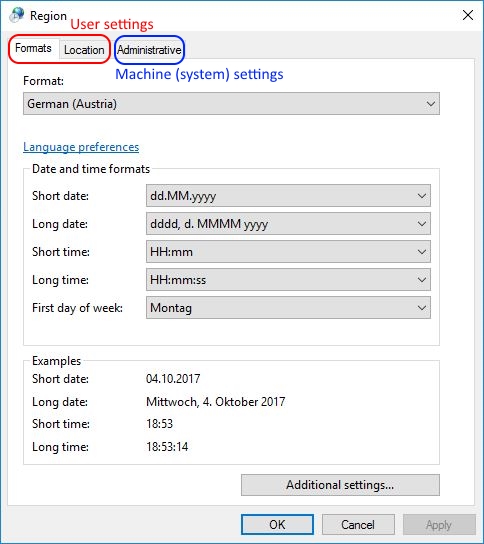
I am sure that you are familiar with the Regional Settings Control Console item. Earlier you continue with the various sections below, I would like to remind y'all of the fact that the tabs Formats and Location contain user-specific settings and that settings on the tab Authoritative are system-specific.
These organization-specific settings concern the international settings for the welcome screen and system accounts as well as the local arrangement's code page for programs that practise non support Unicode. For detailed information how to configure the code folio please see the article Configuring the time zone and lawmaking page with Group Policy on this website.
The residual of this article deals with the user-specific settings (= the offset two tabs) only.
Ane final thing. All configurations described in this article are stored in the Windows registry. If you are unsure of the exact value of a setting, for instance concerning country codes, I recommend you lot to first configure the setting using the graphical interface. You than go to the registry and read the configured value, which you tin than use in your script or Group Policy setting.
Quick list of the main registry values mentioned in this commodity
In case y'all are not in the mood for any blabla, I have listed all relevant registry keys and values in this section. If you know your way around Grouping Policy Preferences, y'all practise not need to read farther. Here it goes.
Regional settings:
Registry key: HKEY_CURRENT_USER\Command Panel\International
Registry value: multiple values in the aforementioned key
Y'all tin configure Regional Settings with the Regional Settings Grouping Policy Preference (User Configuration \ Preferences \ Control Panel Settings \ Regional Options).
24/12 hour clock and AM/PM time settings:
Registry key: HKEY_CURRENT_USER\Control Panel\International
Registry value: sShortTime (REG_SZ)
Yous can configure the fourth dimension settings with the Regional Settings Group Policy Preference or with a Group Policy Preference registry detail.
(Home) location:
Registry primal: HKEY_CURRENT_USER\Control Panel\International\Geo
Registry value: Nation (REG_SZ)
You can configure the (home) location with a Group Policy Preference registry item.
Configuring regional settings using Group Policy
This section deals with the settings configured on the beginning tab,Formats, of the Regional Settings Control Panel item.
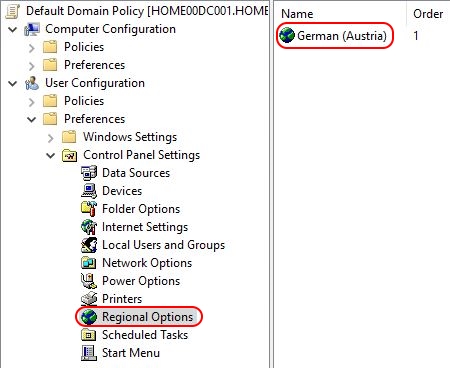
Ever since the introduction of Grouping Policy Preferences with Item-Level Targeting (start introduced with Windows Server 2008), managing regional settings has been a breeze. Open your Group Policy Management Console (GPMC.msc) and navigate to User Configuration \ Preferences \ Control Panel Settings \ Regional Options. With a right-mouse click on Regional Options select New.
Now you can configure your settings the aforementioned fashion as on a local Regional Settings pane.

Annotation: please be enlightened that this policy item requires you to commencement enable underlined settings past pressing the F5 or F6 cardinal before yous tin modify and save them! See the Microsoft commodity Enable and Disable Settings in a Preference Item for more information.
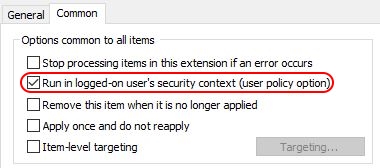
I recommend to execute this policy in the user's security context (tick the Run in logged-on [...] box on the Common tab).
In example you crave multiple Regional Settings configurations inside the aforementioned Group Policy, use an Particular-Level Targeting filter.

I way to distinguish users is to filter based on Active Directory security group membership, for case:
- German (Austria): filtered on the Active Directory Group usrsAustria
- French (France): filtered on the Active Directory Group usrsFrance
- English (The states): filtered on the Active Directory Group usrsEnglish
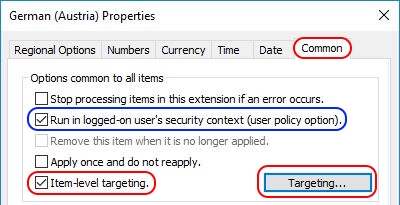
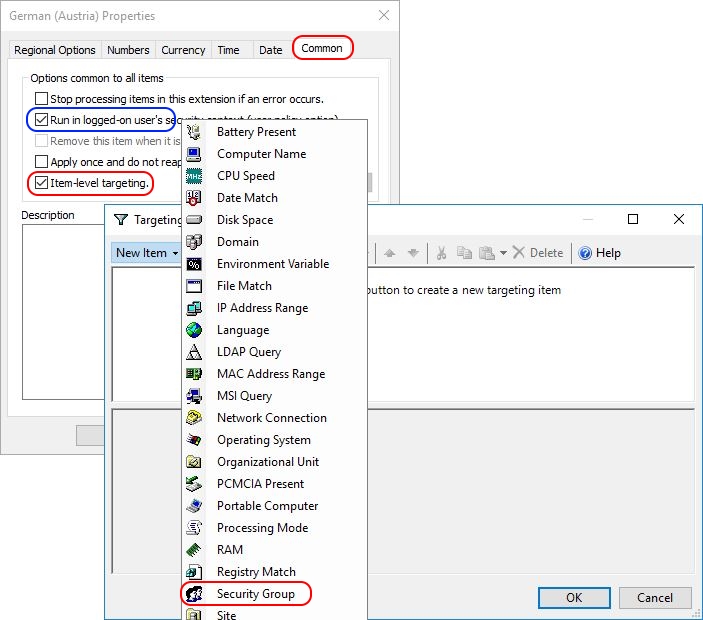
In the end, all regional settings are configured in the registry in the HKEY_CURRENT_USER hive. The regional settings consist of multiple values. Yous find all settings in the following registry key:
Control Console\International
Configuring the 24/12 60 minutes clock and AM/PM using Group Policy
It may happen that after configuring the regional settings for a user, the fourth dimension in the system tray is non shown in the correct format. You can correct the time format on the Time tab in the Regional Settings Group Policy Preference (come across besides the previous paragraph) or directly in the registry (using either a script or a Grouping Policy Preference).
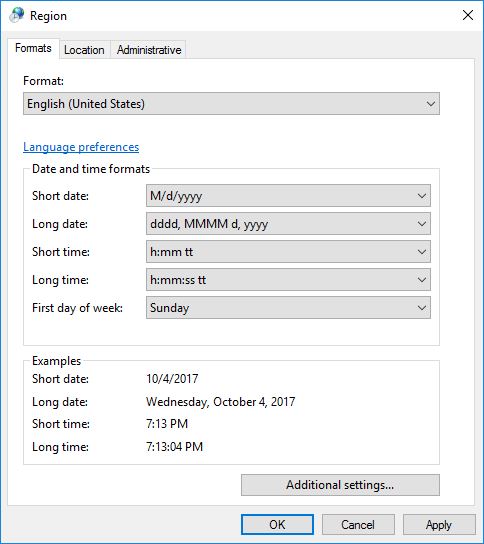
Please have a look at the screenshot below. The regional settings accept been modified from English (United States) to German language (Austria). In most countries in Europe, a 24-hour clock is used without AM / PM at the end. In the instance below, the time is not displayed as information technology should be. In our example, a 12-hour clock is displayed as well every bit AM / PM (nachm. stands for PM in German). What the clock should display is a 24-hr time notation without AM / PM at the cease.
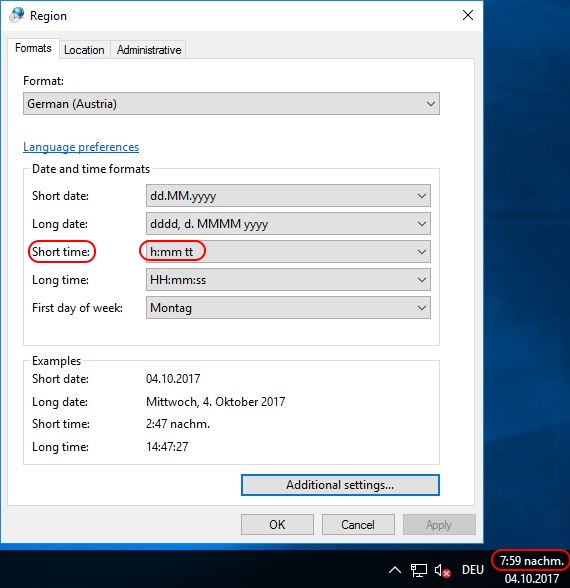
The short time value determines how the fourth dimension in the system tray is displayed; a 24 or 12-hour clock (with or without leading zeros) and with or without AM / PM. This value is written in the registry in the HKEY_CURRENT_USER hive. The exact registry cardinal and value are:
Command Panel\International -> sShortTime (REG_SZ)
The following possible values exist:
- h:mm = 12-hour clock without leading zeros and without AM / PM
- hh:mm = 12-hour clock with leading zeros and without AM / PM
- h:mm tt = 12-hour clock without leading zeros and withAM / PM
- hh:mm tt = 12-hour clock with leading zeros and withAM / PM
- H:mm = 24-hour clock without leading zeros and withoutAM / PM
- HH:mm = 24-60 minutes clock with leading zeros and withoutAM / PM
- H:mm tt = 24-60 minutes clock without leading zeros and withAM / PM
- HH:mm tt = 24-60 minutes clock with leading zeros and withAM / PM
A uppercase H sets the clock to a 24-hour format; a pocket-size h sets the clock to a 12-hour format. A double hh or HH adds a leading nil (when the hour is 1 digit just). Iftt is present at the stop thanAM / PM is displayed. As well, note the space between the clock settings and the tt value.
Here are some examples:
- h:mm = seven:30 or 10:42
- hh:mm = 07:30 or x:42
- h:mm tt = 7:30 AM or 10:42 PM
- hh:mm tt = 07:thirty AM or 10:42 PM
- H:mm = 7:xxx or 23:42
- HH:mm = 07:thirty or 23:42
- H:mm tt = 7:thirty AM or 23:42 PM
- HH:mm tt = 07:30 AM or 23:42 PM
The last two examples in the previous listing will not be used much in practice: a 24-hour clock with AM / PM at the end. The driblet down menu in the Regional Settings does not allow you lot configure this, but yous can configure this on the Time tab of theRegional Settings Grouping Policy Preference and by directly configuring the registry (using a Group Policy Preference registry item for example). Adding the prefix AM / PM to a 24-hour clock notation looks a bit weird, but it is technically possible:

Now we have all the information we need to prepare the correct time configuration for all users. There are two piece of cake ways how to accomplish this:
- Configure the clock using a Regional Settings Group Policy Preference
- Configure the clock using a Group Policy Preference registry item
Configure the clock using a Regional Settings Group Policy Preference
Please read the section Configuring regional settings using Grouping Policy in this article to understand how to configure the user's regional settings. Later on you lot have configured at least one regional setting configuration, modify this configuration and go to the Fourth dimension tab.
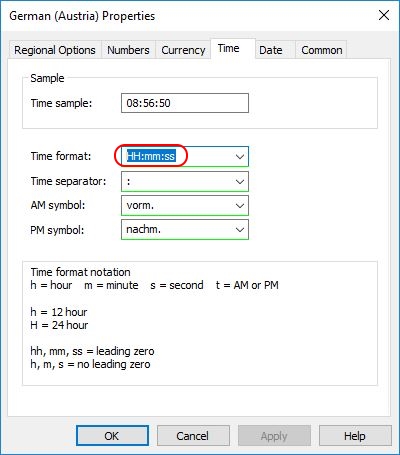
On this tab you lot tin alter the time format to anything you want. Before you can modify annihilation, beginning make sure to press the F5 button to plow all the ruby-red lines to green lines. Greenish lines indicate that anything you change will exist saved afterward clicking the Apply or OK push button. At the bottom of the tab a detailed clarification of the various configuration options is provided. In the example below I changed the format HH:mm:ss to h:mm:ss tt, changing the clock from a 24-hour to a 12-hour clock and addingAM / PM.

Configure the clock using a Group Policy Preference registry item
Open your Group Policy Management Console (GPMC.msc) and navigate to User Configuration \ Preferences \ Windows Settings \ Registry. With a correct-mouse click on Registry select New \ Registry Detail. Configure the registry item as follows:
- Action: replace
- Hive: HKEY_CURRENT_USER
- Central path: Control Panel\International
- Value name: sShortTime
- Value data: <your value>, e.k. HH:mm
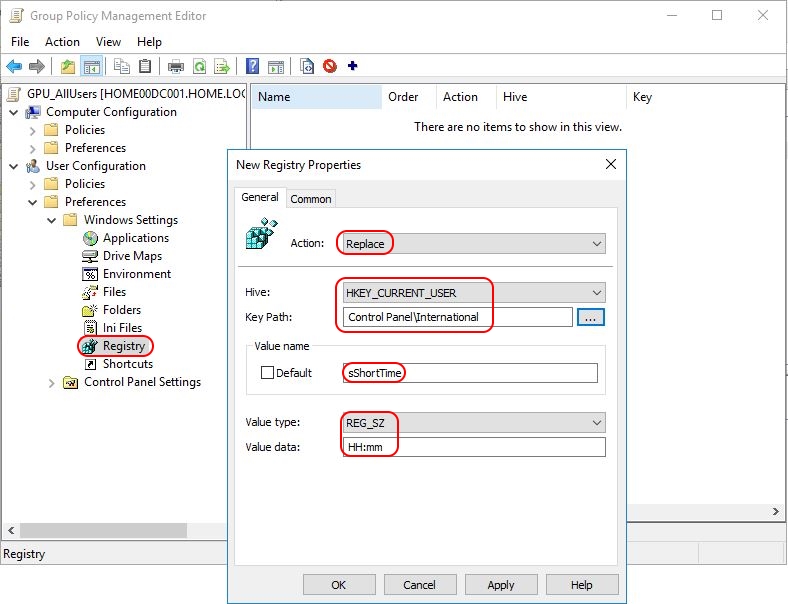
I recommend to execute this policy in the user's security context (tick the Run in logged-on [...] box on the Common tab).
In case you require multiple locations for a variety of scenarios within the same Group Policy, use an Item-Level Targeting filter. This is explained in the section Configuring regional settings using Group Policy.
The registry item is at present created and will be deployed to all users to whom the particular Group Policy applies.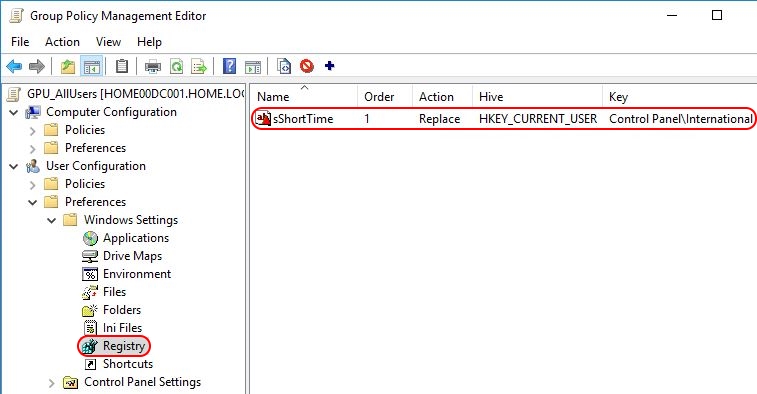
It is possible to rename the registry item afterwards:
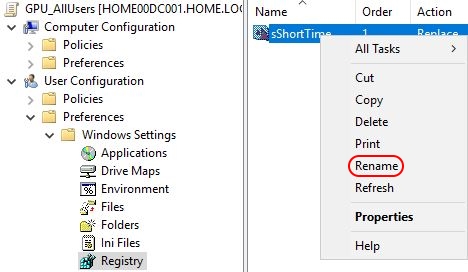
Just remember that modifying the item resets it to its original name (=the value name) and you volition take to rename information technology once more.
Configuring the (dwelling) location setting using Group Policy
This section deals with the Abode Location setting configured on the 2d tab, Location, of the Regional Settings Control Panel item.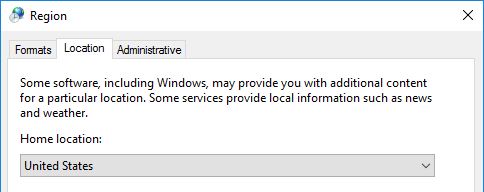
The location cannot be changed using the Regional Settings Group Policy Preference. Instead, a Grouping Policy Preference registry item needs to be used.
The location is stored in the Windows registry in the HKEY_CURRENT_USER hive. The exact registry primal and value are:
Control Panel\International\Geo -> Nation (REG_SZ)
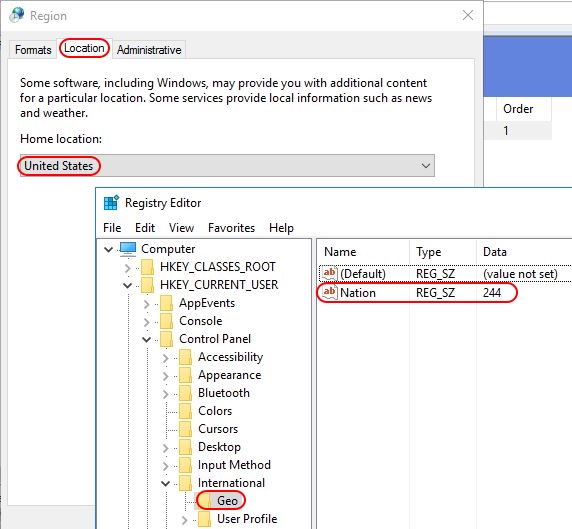
To make up one's mind the country ID, change the location manually on the second tab of the Control Panel item Regional Settings and than check the aforementioned registry value. For instance, when I select Republic of austria every bit my location, the value Nation is set to fourteen. Earlier information technology was 244, which is the country ID for the United States.
Now nosotros accept all the information we need to set the right location for all users. The easiest way to reach this is by using a Group Policy Preference.
Open your Group Policy Management Console (GPMC.msc) and navigate to User Configuration \ Preferences \ Windows Settings \ Registry. With a right-mouse click on Registry select New \ Registry Item. Configure the registry particular as follows:
- Action: replace
- Hive: HKEY_CURRENT_USER
- Key path: Control Panel\International\Geo
- Value name: Nation
- Value information: <your value>, e.one thousand. fourteen

I recommend to execute this policy in the user'south security context (tick the Run in logged-on [...] box on the Common tab).
In example you require multiple locations for a multifariousness of scenarios within the same Grouping Policy, use an Detail-Level Targeting filter. This is explained in the section Configuring regional settings using Group Policy.
The registry item is at present created and will exist deployed to all users to whom the particular Group Policy applies.
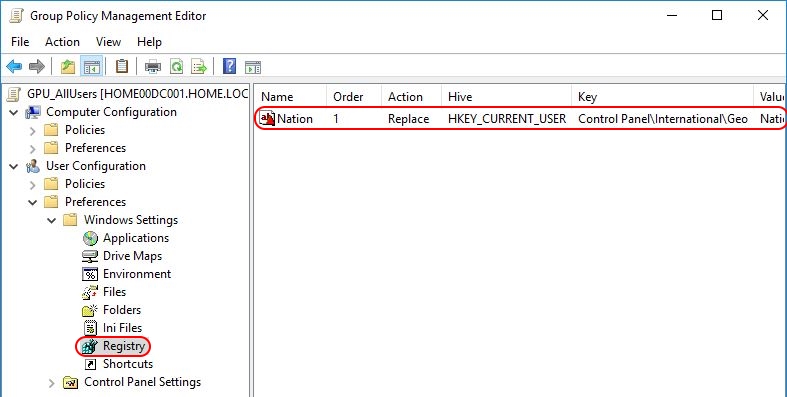
It is possible to rename the registry item subsequently:
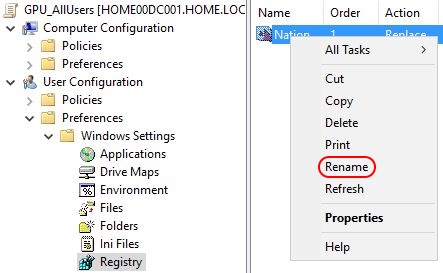
Only recollect that modifying the item resets it to its original name (=the value name) and you will take to rename it again.
I promise this article was of some help to you.

Dennis Span works as a Pb Sales Engineer at Citrix in Vienna, Austria. He holds multiple certifications such equally CCE-V, CCIA and CCEA. In 2017, Dennis became a Citrix Technology Advocate (CTA). In 2019, he became a Citrix Technology Professional person (CTP). Besides his involvement in virtualization technologies and blogging, he loves spending fourth dimension with his family unit as well as snowboarding, playing basketball game and rowing. He is fluent in Dutch, English, German and Slovak and speaks some Spanish.
Source: https://dennisspan.com/configuring-regional-settings-and-windows-locales-with-group-policy/
0 Response to "Can Scw Apply Security Policies to Multiple Servers at a Time?"
Publicar un comentario